The Basket Got Tougher in 2025
If 2025 taught FMCG brands anything, it’s this: staying relevant is no longer about being visible. It’s about being chosen, justified, and chosen again.
Australian shoppers became more deliberate last year. Research from Shop! ANZ and Vypr found price was the strongest purchase driver, 90% of shoppers had bought something simply because it was on promotion, and nearly half said they plan their grocery shopping more now than they did in 2020. At the same time, most grocery purchases still happened in-store, which means the shelf remains the moment of truth.
That shift matters. It means brands are no longer competing only on awareness. They’re competing on relevance in real time, inside a basket that is more edited, more value-conscious, and less forgiving than it was even a year ago. In our view, that’s the real backdrop for 2026.
Value Without Clarity Gets Left Behind
Value is still the biggest conversation in FMCG, but it’s become a more nuanced one.
The ACCC’s supermarket inquiry found convenience and value were the two strongest reasons Australians chose their main grocery retailer, while newer shopper research showed price heavily influences purchase decisions and promotions are actively shaping behaviour.
But value in 2026 is not simply “cheaper”. It’s clearer.
A premium product can still win. A challenger brand can still grow. But both need to answer the same question immediately: why is this worth it? If the value story is vague, the product becomes vulnerable. If the benefit is obvious, the basket can stretch.
That’s why we think brands need to become much sharper in how they present value. Not just in price, but in function, ingredient quality, portion logic, use occasion, and pack architecture. Consumers are still willing to spend, but they’re no longer doing it lazily.
Trust Is Now Part of the Product
There was a time when trust sat mostly in the brand-building category. In 2026, it sits much closer to conversion.
NIQ’s 2026 Consumer Outlook found 95% of consumers say trust is critical when choosing a brand. KPMG’s Australian Retail Outlook also points to transparency and ethical practices as growing expectations, alongside more seamless and personalised shopping experiences.
For FMCG brands, that changes the standard.
Trust is no longer built only through heritage or advertising. It’s built through consistency. Does the pack match the product? Do the claims feel credible? Does the quality stay stable? Does the customer get what they expected the first time, and the second time?
We’re seeing more brands realise that trust now functions as a shortcut. In a crowded category, it reduces hesitation. It gives shoppers permission to buy without overthinking. And in a market where private label has become a more accepted choice, branded products need to work harder to earn that permission every time. NIQ reports that more than half of APAC consumers are now more likely to buy private label than ever before, which tells you the old trust advantages can no longer be taken for granted.
Convenience Has Moved Beyond Proximity
Convenience used to be mostly about location. That’s no longer enough.
The ACCC found convenience was the most commonly selected factor in supermarket choice, while KPMG reported that more than 55% of consumers now expect same-day delivery as standard and 85% blend online and in-store shopping. Australia Post’s 2026 eCommerce Report also showed millennials, Australia’s top online shoppers in 2025, were driven by convenience and value, with 47% shopping online weekly or more.
That points to a broader change: convenience is now about friction.
Can the product be understood quickly? Can it be found easily across channels? Is the pack size right for the mission? Does the retailer page tell the story properly online? Is re-purchase effortless?
This is especially important in petrol and convenience, where the decision window is short and the product has to make sense instantly. But it also matters in mainstream grocery, where shoppers are planning more tightly and making fewer casual decisions. Convenience in 2026 is less about being nearby and more about being easy to choose.
Experience Is What Makes Repeat Purchase Happen
One of the biggest mistakes brands still make is treating product quality as the entire experience.
It isn’t.
The experience starts with discovery, continues through the shelf or digital page, and only then gets tested by the product itself. KPMG notes that seamless omnichannel experiences are becoming the norm and that real-time product availability, frictionless checkout, and transparent supply chains are increasingly baseline expectations.
That matters because repeat purchase rarely comes from one thing. It comes from alignment.
The pack has to look right. The message has to be clear. The price has to feel fair. The retailer has to place it well. The product has to deliver. If one part breaks, the experience weakens.
This is also why convenience stores have been adjusting assortments so aggressively. The channel has been reshaping around ready-made meals, drinks, quick-serve items and self-scan technologies, while cautious spending continues to influence what people pick up.
In other words, the brands that win are not just selling products. They are reducing friction and creating a better experience around the purchase itself.
The Real Lesson From 2025
The biggest lesson from 2025 wasn’t that shoppers stopped spending.
It was that they became more intentional.
Shopper data showed nearly half of consumers are planning more than they did a few years ago, with most doing full shops or top-up essentials rather than shopping for inspiration. The ACCC also found half of respondents typically do one large weekly shop plus smaller top-up missions.
That has major implications for how brands stay relevant.
- If shopping is more planned, then impulse has to work harder.
- If budgets are tighter, the value story has to land faster.
- If trust is under more pressure, the product has to deliver more consistently.
- If channels are blending, the brand has to feel coherent everywhere.
That’s the new rule of relevance. Not bigger campaigns. Better alignment.
What 2026 Will Reward?
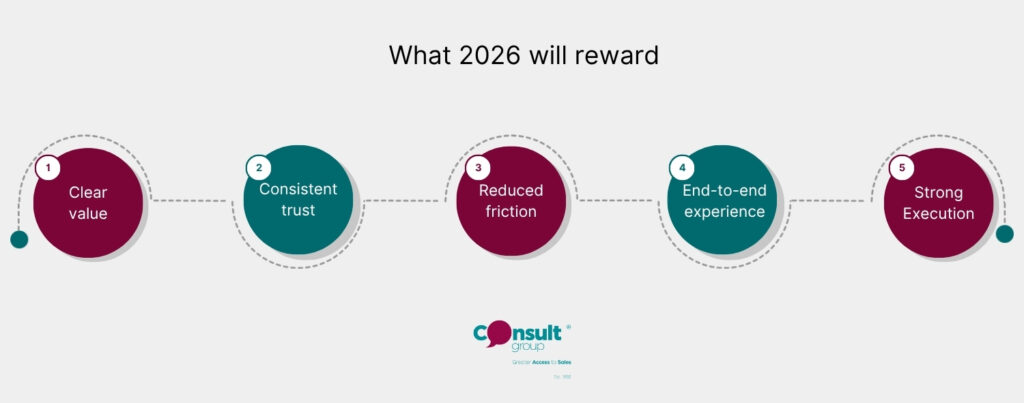
From where we sit, 2026 will reward brands that do five things well.
- They will make value obvious.
- They will build trust through consistency, not just positioning.
- They will remove friction from the path to purchase.
- They will think about experience beyond the product itself.
- And they will execute properly, because none of the above matters if supply, timing, or retail readiness falls over.
This is where we think many brands will either widen the gap or lose it completely. The market is still full of opportunity, but it’s becoming less forgiving of weak execution and vague relevance.
Where We See the Opportunity
At Consult Group, we don’t think the answer is to chase every trend. We think the answer is to become sharper about where your product fits, why it matters, and how it shows up in market.
2025 made one thing very clear: the basket has become more selective.
That means the brands that stay in it in 2026 won’t necessarily be the loudest. They’ll be the clearest. The most trusted. The easiest to buy. The most consistent to experience.
That’s what relevance looks like now.
And that’s what the market is rewarding.
If you’re considering how your brand shows up in a more intentional shop, we’d be happy to talk about where opportunities might exist. Get in touch with our team today.