

Range Reviews Are About More Than Getting on Shelf
For an FMCG brand, few conversations matter more than a range review. It’s where retailers assess what’s working, what isn’t, where the category is heading and which products deserve valuable shelf space for the next cycle. For an emerging brand, it can be the opportunity that opens the door to significant distribution. For an established supplier, it can determine whether you grow your footprint, maintain your position or potentially lose space.
And the opportunity doesn’t come around every month.
Major Australian retailers typically conduct range reviews only once or twice a year within a category. That makes preparation critical. Miss the timing or arrive without a strong enough case and you may have a long wait before the next opportunity.
But one of the biggest misconceptions we see is that a range review is essentially a product pitch.
It isn’t.
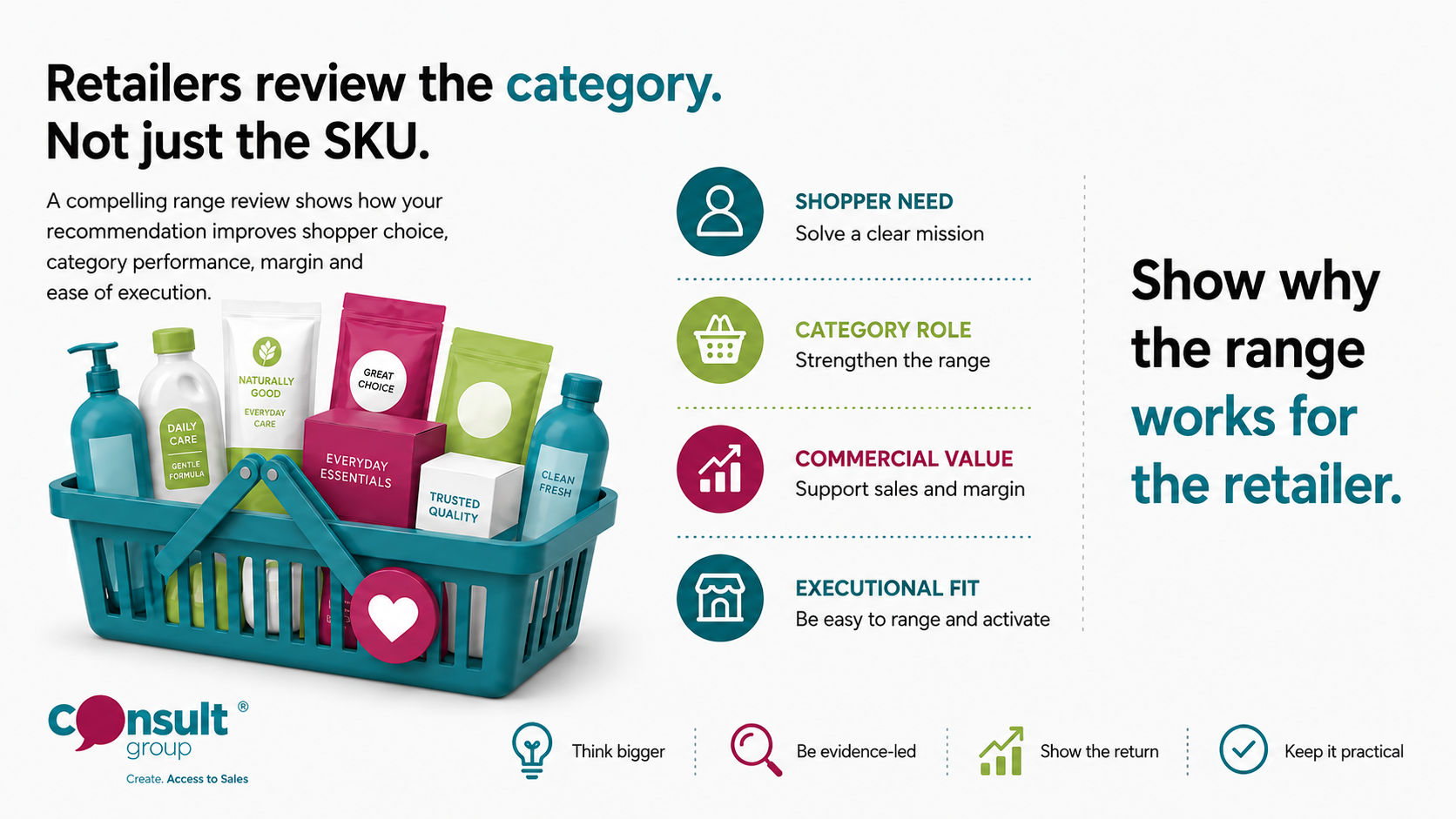
A buyer isn’t simply asking whether they like your product. They’re asking what your product can do for their category.
Understanding that difference changes everything.
Start Preparing Before the Review Starts
Good range review preparation begins well before the submission deadline.
Retailers plan their category calendars months in advance, and brands need to understand when their relevant review is happening, what information will be required and whether the business will actually be ready if the answer is yes.
That last question matters.
There’s little value in securing national ranging if manufacturing, distribution or working capital can’t support it. Likewise, a product shouldn’t be rushed into a review simply because the window is open.
Before approaching the retailer, the fundamentals need to be in place. The product needs to be market-ready, the commercial model needs to work, packaging and product information need to meet requirements, and the supply chain needs to be capable of supporting the opportunity.
At Consult Group, we’ve partnered with hundreds of brands preparing for range reviews. One thing we’ve learnt is that the strongest submissions rarely feel rushed. They’re the result of work that started long before the buyer meeting appeared in the calendar.
Stop Selling the Product and Start Selling the Opportunity
Founders naturally love talking about their products.
They know the ingredients, the story behind the business, why they created it and what makes it special.
All of that matters.
But a retailer needs something more.
They need to understand where the opportunity sits within their category.
That means being able to answer questions such as: Who is going to buy this? What consumer need does it address? Where will the sales come from? Is it genuinely incremental, or will it simply shift sales from another product already on shelf?
Retail buyers are under pressure to improve category performance. Sales velocity, profitability, shopper demand and efficient use of shelf space all matter when ranging decisions are made.
So rather than walking into a review saying, “Here’s why our product is great”, strong brands arrive saying, “Here’s the opportunity we see for your category, and here’s the role our product can play in capturing it.”
It sounds like a small change.
Commercially, it’s a completely different conversation.
Bring Evidence, Not Just Enthusiasm
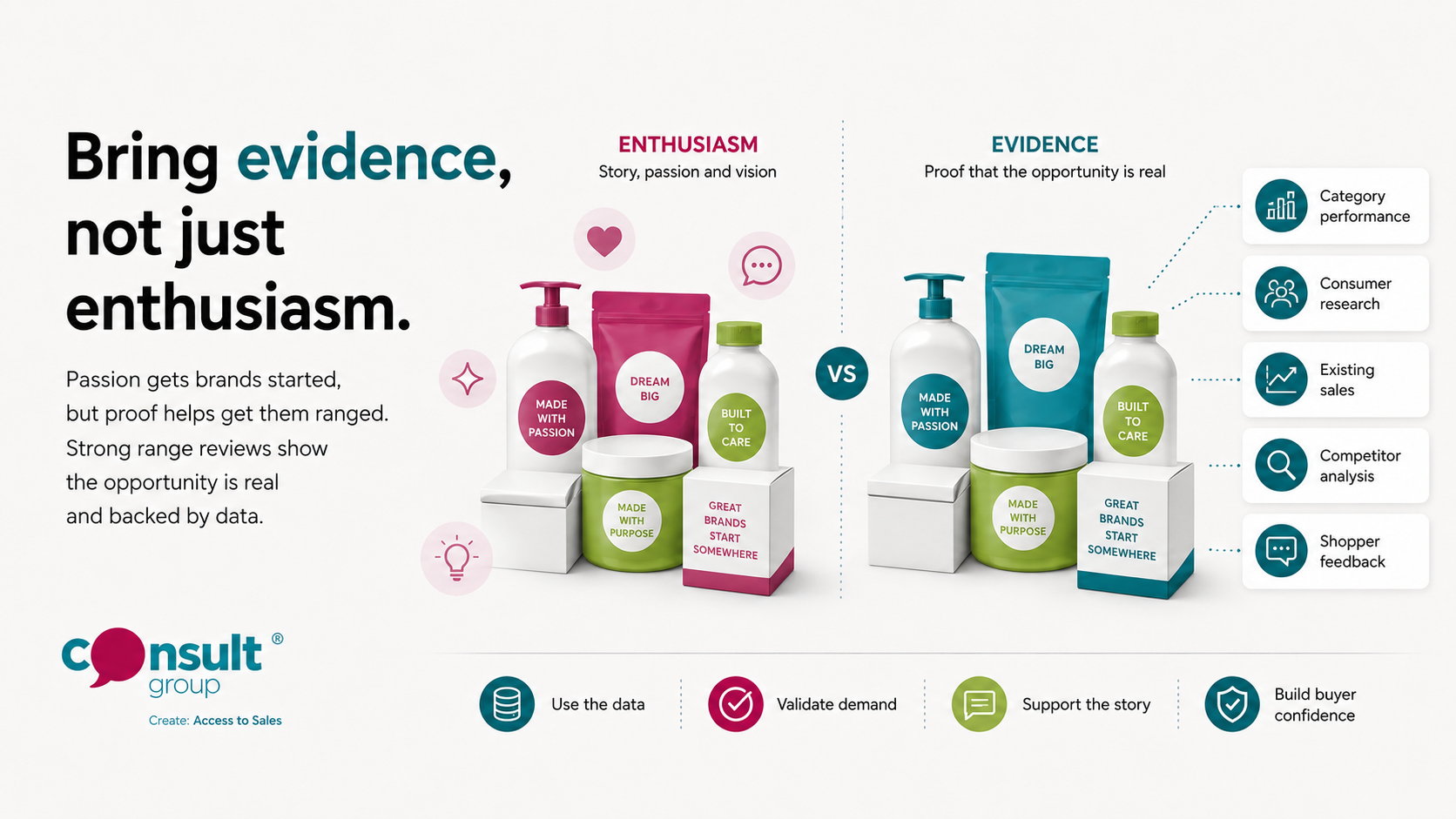
Passion gets brands started. Evidence helps get them ranged.
A strong range review submission needs to demonstrate that the opportunity is real.
That may involve category performance, consumer research, competitor analysis, sales results from existing channels, shopper feedback or evidence of emerging demand.
For newer brands without years of scan data, that doesn’t mean the conversation is over. It simply means the evidence may need to come from elsewhere. Performance through independents, petrol and convenience, direct-to-consumer sales or another retail channel can all help build the story. Consumer research can also help validate whether the proposition, packaging and product itself resonate with the intended shopper.
Stickybeak makes an important point in its range review guidance: the presentation isn’t simply about making a deck look impressive. The job is to find the shopper insight that demonstrates why the product can grow the category and support that argument with proof rather than promises.
That’s the mindset brands need to take into the process.
Know the Shelf You’re Asking to Join
Another mistake we see is brands becoming so focused on their own product that they lose sight of what surrounds it.
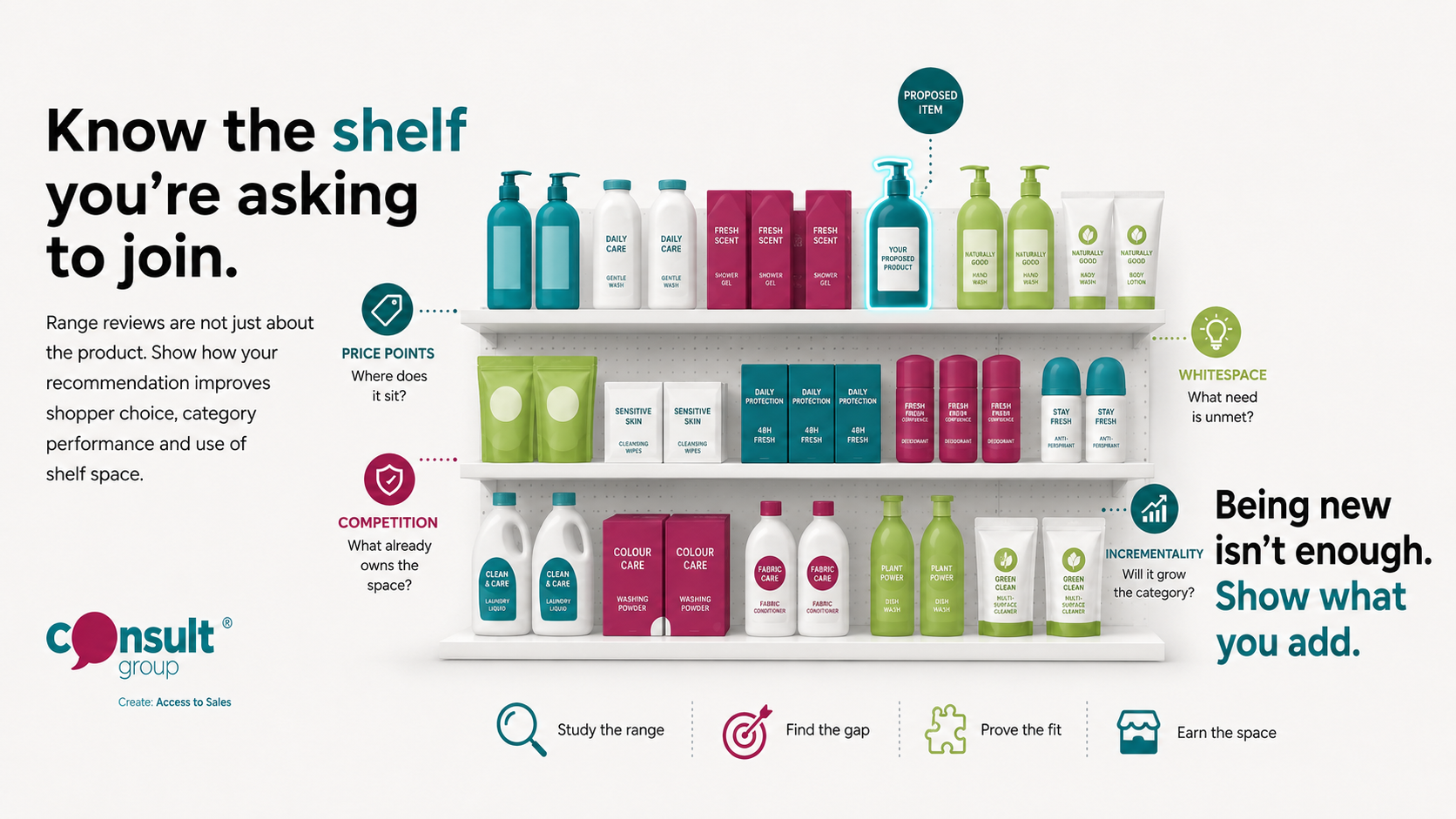
A range review requires a clear understanding of the competitive landscape.
Who already occupies the shelf? Which products appear to be growing? Where are the price points? What formats dominate? Where might there be duplication? And, most importantly, where is there genuine whitespace?
A national Australian retailer can carry somewhere between 17,000 and 23,000 SKUs. Every one of those products is effectively competing for retail real estate.
Your product therefore needs a reason to take somebody else’s space, or to justify the creation of additional space.
That reason needs to be stronger than simply being new.
A new flavour isn’t necessarily innovation. A new format isn’t necessarily an opportunity. What matters is whether the change answers an unmet consumer need or contributes something valuable to the category.
The better you understand the existing range, the easier it becomes to explain where your product belongs within it.
Commercial Readiness Matters
A compelling consumer proposition can get a buyer interested.
The commercial details determine whether the opportunity actually works.
Retailers need confidence that the brand understands pricing, margins, promotional expectations and supply. Packaging and product information need to comply with retailer requirements, while logistics need to support delivery expectations and potentially significant changes in volume.
This is particularly important for emerging brands.
Getting ranged nationally sounds like the finish line. In reality, it can be the beginning of an entirely new set of challenges.
Manufacturing requirements increase. Inventory needs change. Warehousing and distribution become more complex. Marketing investment may need to grow. Cash can become tied up in stock long before retailer revenue reaches the business.
These aren’t reasons to avoid growth.
They’re reasons to prepare for it.
The best outcome from a range review isn’t simply getting a yes. It’s securing an opportunity the business is actually capable of executing successfully.
The Relationship Doesn’t Start and Finish in the Meeting
Range reviews are important moments, but strong retailer relationships are built between them.
The brands that tend to develop the best retail partnerships are those that stay engaged with the category throughout the year.
They communicate openly. They understand what’s happening in the market. They bring useful insights to buyers. They address problems quickly. And when something isn’t performing as expected, they arrive with a solution rather than waiting for the retailer to raise the issue.
This matters because range reviews are not only about getting new products onto shelves.
They’re also about keeping existing ones there.
At Consult Group, we’ve spent more than three decades developing relationships with FMCG buyers across Australia. What those years reinforce is that trust carries enormous weight in this industry. Retailers want suppliers who understand their business, deliver what they promise and are prepared to work collaboratively when circumstances change.
A great range review presentation can open the conversation.
What happens afterwards determines the relationship.
Getting a Yes Is Only the Beginning
Winning ranging is a major achievement, particularly for an emerging FMCG brand.
But shelf space isn’t permanent.
Once the product launches, performance starts building the case for the next review.
Sales matter. So does promotional performance, availability, profitability, supply reliability and the brand’s ability to respond to changing consumer behaviour.
This is where range review strategy connects with ongoing category management.
At Consult Group, our category management work covers areas including forecasting, promotional profitability, competitor and pricing analysis, cost management and supply-chain logistics.
These are ongoing commercial disciplines because getting a product ranged and keeping it successfully ranged are two different challenges.
The brands that understand this don’t treat range reviews as isolated events.
They treat them as part of an ongoing retailer strategy.
Where Consult Group Fits In
Range reviews can be intimidating, particularly when you’re approaching a major Australian retailer for the first time.
But they become considerably easier to navigate when you understand what the retailer needs from the conversation.
At Consult Group, we’ve partnered with hundreds of brands to prepare for range reviews across grocery, petrol and convenience and other major retail channels. We combine market data, category insights and more than three decades of retailer relationships to help brands understand where the opportunity lies and how best to present it.
Sometimes that means strengthening the category story. Sometimes it means challenging the ranging strategy. And sometimes the right advice is that the brand isn’t ready yet.
Because the objective isn’t simply to get into the meeting.
It’s to arrive with the strongest possible reason for the retailer to say yes.
Final Thought
A successful range review isn’t won by the prettiest presentation or the founder with the most enthusiasm.
It’s won through preparation.
Know the retailer. Understand the category. Find the opportunity. Bring evidence. Get the commercial fundamentals right. And be ready to deliver if the answer is yes.
Most importantly, remember that the buyer isn’t simply deciding whether your product deserves a place on the shelf.
They’re deciding whether your brand can help make the category better.
That’s the case you need to make.